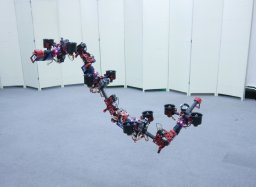
Learning Agile and Robust Omnidirectional Aerial Motion on Overactuated Tiltable-Quadrotors
career value
188K/year
🤖 AI Summary
This work proposes the first reinforcement learning–based six-degree-of-freedom SE(3) pose tracking control framework for over-actuated quadrotor tilt-rotor aerial vehicles, addressing the challenges of insufficient robustness and agility under strongly coupled dynamics, disturbances, and model uncertainties. By integrating system identification with a physically consistent, lightweight domain randomization strategy, the method coordinates rotor and joint actuation to achieve high-precision trajectory tracking while enabling zero-shot sim-to-real transfer. Experimental results demonstrate that the proposed approach matches the pose tracking accuracy of state-of-the-art nonlinear model predictive control (NMPC) methods while significantly enhancing robustness and generalization across diverse disturbance conditions and task scenarios. Notably, it achieves successful deployment on real hardware without any fine-tuning.
Application Category
📝 Abstract
Tilt-rotor aerial robots enable omnidirectional maneuvering through thrust vectoring, but introduce significant control challenges due to the strong coupling between joint and rotor dynamics. While model-based controllers can achieve high motion accuracy under nominal conditions, their robustness and responsiveness often degrade in the presence of disturbances and modeling uncertainties. This work investigates reinforcement learning for omnidirectional aerial motion control on over-actuated tiltable quadrotors that prioritizes robustness and agility. We present a learning-based control framework that enables efficient acquisition of coordinated rotor-joint behaviors for reaching target poses in the $SE(3)$ space. To achieve reliable sim-to-real transfer while preserving motion accuracy, we integrate system identification with minimal and physically consistent domain randomization. Compared with a state-of-the-art NMPC controller, the proposed method achieves comparable six-degree-of-freedom pose tracking accuracy, while demonstrating superior robustness and generalization across diverse tasks, enabling zero-shot deployment on real hardware.
Problem
Research questions and friction points this paper is trying to address.
omnidirectional aerial motion
tiltable quadrotors
robustness
agility
control challenges
Innovation
Methods, ideas, or system contributions that make the work stand out.
reinforcement learning
tiltable quadrotor
omnidirectional motion
sim-to-real transfer
robust control
🔎 Similar Papers
2022-09-20IEEE Robotics and Automation LettersCitations: 0
💼 Related Jobs