🤖 AI Summary
This work proposes a novel architecture integrating shared intelligence and embodied cognition to enhance safety and efficiency in human-robot physical collaboration. For the first time, ergonomic metrics are jointly embedded into both the hardware morphology and physical intelligence control of a humanoid robot. By leveraging human motion modeling, constructing human-robot interaction functions, and co-optimizing morphology and control, the project develops ergoCub—a human-centered humanoid platform. Experimental results demonstrate that the system significantly improves ergonomic performance during collaborative tasks, establishing a new paradigm for human-robot cooperation that simultaneously ensures safety, efficiency, and human adaptability.
📝 Abstract
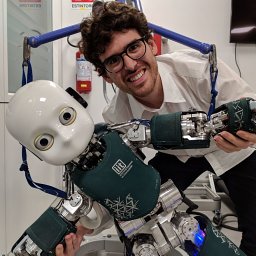
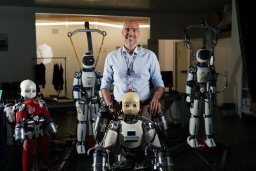
Collaboration is central to human behavior, enabling tasks beyond individual capability. This ability arises from coordinating actions through internal representations of others, a concept known as shared intelligence. Additionally, humans are characterized by physical bodies and cognitive abilities that are optimized in response to their environment, a phenomenon referred to as embodied cognition. Designing humanoid robots that collaborate safely and effectively with people requires unifying these principles. Here we propose an architecture that integrates shared intelligence and embodied cognition to enable robots to physically collaborate with humans, where robot hardware and control are optimized for human metrics, using representations of the human body and motion intelligence. The ultimate goal is to achieve a form of shared embodied intelligence. Specifically, our architecture optimizes robot hardware and physical intelligence parameters with respect to human ergonomic metrics. This is accomplished by modeling human-robot interaction as a function of hardware configurations and embedding human models into the robot's physical intelligence. As a concrete implementation, we present the humanoid robot ergoCub, whose morphology and control have been optimized for collaborative tasks with humans. Our approach provides a framework for designing humanoid robots that prioritize human ergonomics at both the hardware and physical intelligence levels, with applications in industrial and assistive robotics.