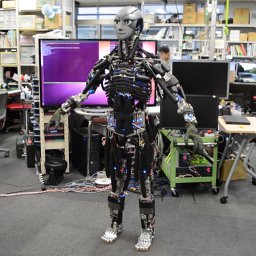
Online Learning of Danger Avoidance for Complex Structures of Musculoskeletal Humanoids and Its Applications
career value
273K/year
🤖 AI Summary
Musculoskeletal humanoid robots face significant safety challenges due to complex biomechanical modeling, strong internal disturbances, and high muscular forces that risk joint interference and structural damage. To address this, we propose an online-learning muscle-length–hazard-probability mapping network for proactive hazard prediction and real-time avoidance. Methodologically, we introduce the first online adaptive modeling framework for musculoskeletal hazard probability, integrating muscle-length state sensing, online neural network training, and closed-loop safety-enhanced control. Unlike conventional reactive safety mechanisms, our approach shifts safety policy from post-hoc compensation to pre-emptive prevention and enables continuous safety adaptation in dynamic environments. Experimental validation on the Musashi robotic platform demonstrates a substantial reduction in high-force muscular conflicts and joint interference events, significantly improving motion robustness and long-term operational safety.
Application Category
📝 Abstract
The complex structure of musculoskeletal humanoids makes it difficult to model them, and the inter-body interference and high internal muscle force are unavoidable. Although various safety mechanisms have been developed to solve this problem, it is important not only to deal with the dangers when they occur but also to prevent them from happening. In this study, we propose a method to learn a network outputting danger probability corresponding to the muscle length online so that the robot can gradually prevent dangers from occurring. Applications of this network for control are also described. The method is applied to the musculoskeletal humanoid, Musashi, and its effectiveness is verified.
Problem
Research questions and friction points this paper is trying to address.
Online learning for danger avoidance
Musculoskeletal humanoids complexity
Preventive safety mechanisms
Innovation
Methods, ideas, or system contributions that make the work stand out.
Online danger probability learning
Muscle length-based prevention
Applied to Musashi humanoid
🔎 Similar Papers
No similar papers found.
💼 Related Jobs