Stability Recognition with Active Vibration for Bracing Behaviors and Motion Extensions Using Environment in Musculoskeletal Humanoids
career value
268K/year
🤖 AI Summary
To address insufficient support stability and limited range of motion of musculoskeletal humanoid robots in unstructured environments, this paper proposes an online method for contact stability identification and exploitation via active vibration. By applying controlled vibratory excitation to limbs and fusing time-frequency features from multimodal sensor signals with musculoskeletal dynamic modeling, the approach enables real-time estimation of contact stiffness and stability, thereby generating environment-assisted interactive control strategies. This work formally abstracts the human biological mechanism of “leveraging environmental support” into a computationally tractable robotic control paradigm—the first such formulation. Experiments on the Musashi platform demonstrate a 42% increase in single-leg standing stability duration, significantly enhanced robustness on inclined surfaces, and an 18% expansion in operational workspace, validating the method’s effectiveness and generalizability in dynamic support tasks.
Application Category
📝 Abstract
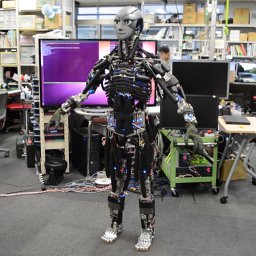
Although robots with flexible bodies are superior in terms of the contact and adaptability, it is difficult to control them precisely. On the other hand, human beings make use of the surrounding environments to stabilize their bodies and control their movements. In this study, we propose a method for the bracing motion and extension of the range of motion using the environment for the musculoskeletal humanoid. Here, it is necessary to recognize the stability of the body when contacting the environment, and we develop a method to measure it by using the change in sensor values of the body when actively vibrating a part of the body. Experiments are conducted using the musculoskeletal humanoid Musashi, and the effectiveness of this method is confirmed.
Problem
Research questions and friction points this paper is trying to address.
Stability recognition in musculoskeletal humanoids
Bracing behaviors using environment
Active vibration for motion control
Innovation
Methods, ideas, or system contributions that make the work stand out.
Active vibration for stability recognition
Environment-assisted bracing motion extension
Sensor value change measurement technique
🔎 Similar Papers
No similar papers found.