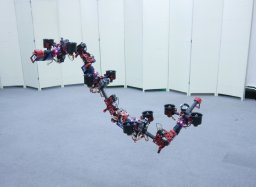
Flexible Morphing Aerial Robot with Inflatable Structure for Perching-based Human-Robot Interaction
career value
187K/year
🤖 AI Summary
Achieving safe, compliant perching of aerial robots on human skin remains challenging due to stringent requirements for non-invasiveness, disturbance rejection, and mechanical adaptability.
Method: This paper introduces a reconfigurable quadrotor platform integrating a unilateral soft robotic arm with pneumatic inflatable actuators. A hybrid morphing structure and real-time pneumatic pressure regulation enable rigid-body flight stability and active softening during perching—yielding high compliance, adaptive grasping, and impact absorption.
Contribution/Results: We present the first demonstration of non-damaging, disturbance-resilient, and fully recoverable compliant perching of a flying robot directly on human skin. Experimental validation confirms autonomous structural recovery after thrust-induced arm deformation, while preserving modeling fidelity and control performance of conventional quadrotors. The system establishes a novel hardware paradigm for embodied human–robot coexistence, bridging aerial mobility with safe, adaptive physical interaction.
Application Category
📝 Abstract
Birds in nature perform perching not only for rest but also for interaction with human such as the relationship with falconers. Recently, researchers achieve perching-capable aerial robots as a way to save energy, and deformable structure demonstrate significant advantages in efficiency of perching and compactness of configuration. However, ensuring flight stability remains challenging for deformable aerial robots due to the difficulty of controlling flexible arms. Furthermore, perching for human interaction requires high compliance along with safety. Thus, this study aims to develop a deformable aerial robot capable of perching on humans with high flexibility and grasping ability. To overcome the challenges of stability of both flight and perching, we propose a hybrid morphing structure that combines a unilateral flexible arm and a pneumatic inflatable actuators. This design allows the robot's arms to remain rigid during flight and soft while perching for more effective grasping. We also develop a pneumatic control system that optimizes pressure regulation while integrating shock absorption and adjustable grasping forces, enhancing interaction capabilities and energy efficiency. Besides, we focus on the structural characteristics of the unilateral flexible arm and identify sufficient conditions under which standard quadrotor modeling and control remain effective in terms of flight stability. Finally, the developed prototype demonstrates the feasibility of compliant perching maneuvers on humans, as well as the robust recovery even after arm deformation caused by thrust reductions during flight. To the best of our knowledge, this work is the first to achieve an aerial robot capable of perching on humans for interaction.
Problem
Research questions and friction points this paper is trying to address.
Develop a deformable aerial robot for safe perching on humans
Overcome flight stability challenges in flexible morphing robots
Achieve compliant grasping with hybrid rigid-soft structure
Innovation
Methods, ideas, or system contributions that make the work stand out.
Hybrid morphing structure with flexible arm and inflatable actuators
Pneumatic control system for pressure regulation and shock absorption
Quadrotor modeling adapted for flight stability with flexible arms
🔎 Similar Papers
No similar papers found.