🤖 AI Summary
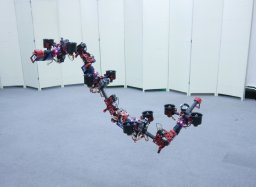
This work addresses the longstanding design trade-off in multirotor aerial vehicles between agile navigation and robust environmental interaction. The authors propose LEGION, a reconfigurable modular flying robot inspired by ant collectives, capable of mid-air self-assembly through a novel zero-clearance self-locking docking mechanism and end-to-end coupling. This enables seamless morphological transitions between individual flight and collective manipulation, forming collaborative aerial manipulators. The system integrates modular joint interfaces, autonomous docking algorithms, and closed-loop contact force/torque control to support aerial manipulation primitives such as pushing, pulling, rotating, grasping, and transporting. Experimental results demonstrate reliable autonomous docking, stable inter-module connections, and diverse physical interaction tasks performed by multiple units in outdoor environments, significantly expanding the capability frontier of aerial robots from passive observation to active environmental engagement.
📝 Abstract
Multirotor aerial robots excel at maneuvering in three-dimensional space, and recent advances enable nimble navigation in cluttered and confined environments, especially for small airframes. By contrast, platforms built for high-altitude work tend to be larger to deliver high thrust for stable physical interaction with the environment. However, these conflicting design requirements create a long-standing trade-off between nimble navigation and robust aerial manipulation. Here, we present LEGION units, which are reconfigurable modular aerial robots capable of in-flight self-assembly for cooperative manipulation, drawing inspiration from the self-organized collectives formed by ants. Each unit retains nimble maneuverability while joint-equipped docking interfaces at both ends enable end-to-end self-assembly into a flying manipulator. We show that multiple units autonomously dock in flight; once latched, they maintain a zero-clearance interlock by controlling the contact force and torque, enabling reliable aggregation and articulated motion even outdoors. We further show that self-reconfigurability enables morphological switching between nimble individual flight and collective articulated manipulation, while realizing core in-flight manipulation primitives including pushing, pulling, rotating, grasping, and carrying. LEGION's self-organization enables aerial robots, especially in swarms, to shift from passive observers to active participants in their environment, broadening the scope of aerial physical interaction.