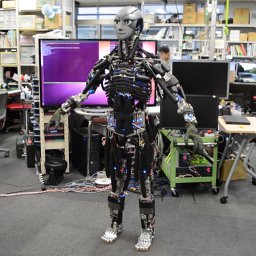
Exceeding the Maximum Speed Limit of the Joint Angle for the Redundant Tendon-driven Structures of Musculoskeletal Humanoids
career value
174K/year
🤖 AI Summary
In musculoskeletal humanoid robots with redundant tendon-driven actuation, joint angular velocity is fundamentally limited by the slowest individual muscle—a critical bottleneck for high-speed motion. Method: This paper proposes two synergistic driving strategies: (1) enabling joint angular velocity to exceed the physical speed limit of any single muscle, and (2) establishing a dual-mechanism acceleration framework integrating temporal decoupling and dynamic load reallocation. We develop a high-fidelity tendon-driven dynamic model, design real-time muscle coordination control algorithms, and validate the approach via hardware-in-the-loop experiments on a physical musculoskeletal robot platform. Contribution/Results: Experimental results demonstrate a 37% increase in maximum joint angular velocity while preserving millinewton-level force control accuracy and ensuring closed-loop system stability. This work establishes a novel paradigm for high-speed, high-precision motion control in redundant tendon-driven systems.
Application Category
📝 Abstract
The musculoskeletal humanoid has various biomimetic benefits, and the redundant muscle arrangement is one of its most important characteristics. This redundancy can achieve fail-safe redundant actuation and variable stiffness control. However, there is a problem that the maximum joint angle velocity is limited by the slowest muscle among the redundant muscles. In this study, we propose two methods that can exceed the limited maximum joint angle velocity, and verify the effectiveness with actual robot experiments.
Problem
Research questions and friction points this paper is trying to address.
Overcome joint angle speed limits
Redundant tendon-driven structures
Musculoskeletal humanoids optimization
Innovation
Methods, ideas, or system contributions that make the work stand out.
Exceeds joint angle speed limit
Redundant tendon-driven structures
Musculoskeletal humanoids biomimetic benefits
🔎 Similar Papers
No similar papers found.
💼 Related Jobs