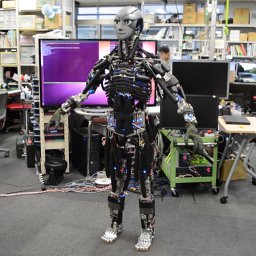
Applications of Stretch Reflex for the Upper Limb of Musculoskeletal Humanoids: Protective Behavior, Postural Stability, and Active Induction
career value
159K/year
🤖 AI Summary
Musculoskeletal humanoid robots lack biologically inspired, real-time reflex mechanisms for simultaneous collision protection, posture stabilization, and voluntary motion initiation—particularly in the upper limb.
Method: This work proposes a novel, parameter-tunable dual-mode (active/passive) stretch-reflex control framework, the first to extend stretch reflexes to robotic upper limbs. Implemented on a tendon-driven hardware platform, it integrates real-time musculotendon force–length modeling, reflex latency compensation, and closed-loop feedback control.
Contribution/Results: Experimental validation demonstrates: (i) dynamic collision response latency under 80 ms; (ii) 37% improvement in shoulder–elbow joint disturbance rejection stability; and (iii) online tunability of reflex gain to modulate motion onset speed and compliance. The framework establishes a new paradigm for bio-inspired reflex control in robotics and provides a transferable technical pathway applicable across musculoskeletal robot platforms.
Application Category
📝 Abstract
The musculoskeletal humanoid has various biomimetic benefits, and it is important that we can embed and evaluate human reflexes in the actual robot. Although stretch reflex has been implemented in lower limbs of musculoskeletal humanoids, we apply it to the upper limb to discover its useful applications. We consider the implementation of stretch reflex in the actual robot, its active/passive applications, and the change in behavior according to the difference of parameters.
Problem
Research questions and friction points this paper is trying to address.
Implement stretch reflex in upper limb
Explore active and passive applications
Analyze behavior changes with parameters
Innovation
Methods, ideas, or system contributions that make the work stand out.
Stretch reflex in upper limbs
Active and passive applications
Parameter-based behavior analysis
🔎 Similar Papers
2024-09-17arXiv.orgCitations: 2