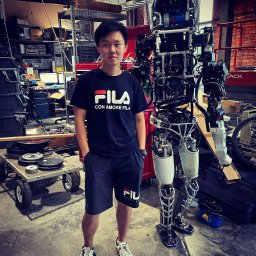
Learning Koopman Dynamics for Safe Legged Locomotion with Reinforcement Learning-based Controller
career value
175K/year
🤖 AI Summary
Bipedal robot navigation is hindered by complex, nonlinear dynamics—including whole-body coupling and discrete contact events—leading to insufficient safety and predictability in conventional control strategies. To address this, we propose a Koopman-MPC fusion framework: for the first time, we embed DMD-driven Koopman linearization into the closed-loop control of a reinforcement learning (RL) policy, enabling runtime state-constraint satisfaction without prior dynamical models or control-theoretic expertise. By distilling interpretable and verifiable linear dynamical representations from a black-box RL policy, and integrating them within a model predictive control (MPC) scheme, our approach ensures safe, real-time navigation. In dense, narrow-corridor scenarios, it reduces collision rate by 42% and trajectory prediction error by 31% compared to nonlinear baselines, significantly enhancing the safety and reliability of agile locomotion.
Application Category
📝 Abstract
Learning-based algorithms have demonstrated impressive performance in agile locomotion of legged robots. However, learned policies are often complex and opaque due to the black-box nature of learning algorithms, which hinders predictability and precludes guarantees on performance or safety. In this work, we develop a novel safe navigation framework that combines Koopman operators and model-predictive control (MPC) frameworks. Our method adopts Koopman operator theory to learn the linear evolution of dynamics of the underlying locomotion policy, which can be effectively learned with Dynamic Mode Decomposition (DMD). Given that our learned model is linear, we can readily leverage the standard MPC algorithm. Our framework is easy to implement with less prior knowledge because it does not require access to the underlying dynamical systems or control-theoretic techniques. We demonstrate that the learned linear dynamics can better predict the trajectories of legged robots than baselines. In addition, we showcase that the proposed navigation framework can achieve better safety with less collisions in challenging and dense environments with narrow passages.
Problem
Research questions and friction points this paper is trying to address.
Addressing nonlinear dynamics in bipedal robot navigation
Improving trajectory prediction accuracy using Koopman operator
Enhancing safety and success rates in dense environments
Innovation
Methods, ideas, or system contributions that make the work stand out.
Uses Koopman operator for linearized dynamics
Learns high-dimensional lifted space via DMD
Applies MPC with quadratic objective optimization
🔎 Similar Papers
2024-08-08arXiv.orgCitations: 7
💼 Related Jobs