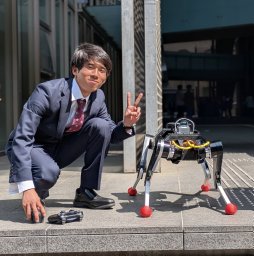
KLEIYN : A Quadruped Robot with an Active Waist for Both Locomotion and Wall Climbing
career value
213K/year
🤖 AI Summary
Quadrupedal robots struggle to achieve stable climbing on highly irregular terrain with significant elevation variations—particularly narrow, vertical walls. Method: This paper introduces KLEIYN, a novel quadruped robot equipped with an actively actuated waist joint, and proposes a Contact-Guided Curriculum Learning (CGCL) framework. By integrating dynamic modeling, reinforcement learning, and coordinated control of the waist-driven mechanism, KLEIYN enables multimodal locomotion planning and real-time stability regulation. Contribution/Results: Experiments demonstrate that KLEIYN achieves stable climbing on chimney-like vertical walls 800–1000 mm wide at an average speed of 150 mm/s—50× faster than conventional approaches. The active waist significantly improves contact robustness and trajectory tracking accuracy. This work establishes a new paradigm for vertical mobility in complex, unstructured environments.
Application Category
📝 Abstract
In recent years, advancements in hardware have enabled quadruped robots to operate with high power and speed, while robust locomotion control using reinforcement learning (RL) has also been realized. As a result, expectations are rising for the automation of tasks such as material transport and exploration in unknown environments. However, autonomous locomotion in rough terrains with significant height variations requires vertical movement, and robots capable of performing such movements stably, along with their control methods, have not yet been fully established. In this study, we developed the quadruped robot KLEIYN, which features a waist joint, and aimed to expand quadruped locomotion by enabling chimney climbing through RL. To facilitate the learning of vertical motion, we introduced Contact-Guided Curriculum Learning (CGCL). As a result, KLEIYN successfully climbed walls ranging from 800 mm to 1000 mm in width at an average speed of 150 mm/s, 50 times faster than conventional robots. Furthermore, we demonstrated that the introduction of a waist joint improves climbing performance, particularly enhancing tracking ability on narrow walls.
Problem
Research questions and friction points this paper is trying to address.
Develop quadruped robot for stable vertical movement in rough terrains
Enable chimney climbing using reinforcement learning and waist joint
Improve climbing performance and tracking on narrow walls
Innovation
Methods, ideas, or system contributions that make the work stand out.
Quadruped robot with active waist joint
Contact-Guided Curriculum Learning (CGCL)
Reinforcement learning for chimney climbing
🔎 Similar Papers
2024-09-30arXiv.orgCitations: 2