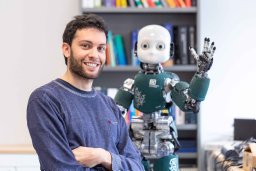
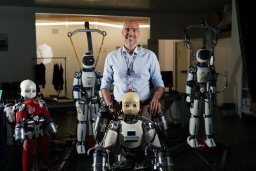
iRonCub 3: The Jet-Powered Flying Humanoid Robot
career value
223K/year
🤖 AI Summary
Jet-powered full-scale humanoid robots present unique challenges in flight control, state estimation, and system integration due to their high dynamics, strong body coupling, and non-conventional morphology. To address these, this work proposes an integrated technical framework: (1) a lightweight jet propulsion system; (2) a model predictive control (MPC)-based whole-body dynamics controller; (3) a multi-sensor fusion state estimator; (4) a real-time simulation and hardware-in-the-loop validation platform; and (5) safety protocols for high-risk outdoor experimentation. Key contributions include: the world’s first autonomous takeoff of a jet-powered humanoid robot; stable takeoff and precise trajectory tracking demonstrated in both simulation and hardware experiments; and the establishment of the first dedicated, high-safety outdoor test facility specifically designed for humanoid flight research—meeting stringent operational and safety requirements for aerial humanoid experimentation.
Application Category
📝 Abstract
This article presents iRonCub 3, a jet-powered humanoid robot, and its first flight experiments. Unlike traditional aerial vehicles, iRonCub 3 aims to achieve flight using a full-body humanoid form, which poses unique challenges in control, estimation, and system integration. We highlight the robot's current mechanical and software architecture, including its propulsion system, control framework, and experimental infrastructure. The control and estimation framework is first validated in simulation by performing a takeoff and tracking a reference trajectory. Then, we demonstrate, for the first time, a liftoff of a jet-powered humanoid robot - an initial but significant step toward aerial humanoid mobility. Also, we detail how the experimental area around a jet-powered humanoid robot should be designed in order to deal with a level of complexity that is substantially superior than indoor humanoid robot experiments.
Problem
Research questions and friction points this paper is trying to address.
Achieving flight with a full-body humanoid robot
Addressing unique control and estimation challenges
Designing experimental infrastructure for jet-powered humanoids
Innovation
Methods, ideas, or system contributions that make the work stand out.
Jet-powered full-body humanoid flight system
Advanced control and estimation framework
Specialized experimental area for jet propulsion
🔎 Similar Papers
No similar papers found.
💼 Related Jobs