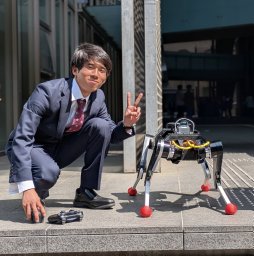
MEVIUS2: Practical Open-Source Quadruped Robot with Sheet Metal Welding and Multimodal Perception
career value
274K/year
🤖 AI Summary
This work addresses the limitations of existing open-source quadrupedal robots—such as structural fragility, small scale, and inadequate perception capabilities—that hinder their practical deployment. To overcome these challenges, the authors present MEVIUS2, an open-source quadruped approaching the size of Boston Dynamics’ Spot. MEVIUS2 is the first open-source platform to integrate sheet-metal welding with precision metal machining, yielding a lightweight yet robust mechanical structure. It further incorporates a LiDAR and a high-dynamic-range camera to enable multimodal environmental perception. Coupled with reinforcement learning–based control algorithms, MEVIUS2 demonstrates stable locomotion and accurate perception across diverse complex terrains. The complete hardware and software designs, along with the training environment, are publicly released, significantly enhancing the reproducibility and real-world applicability of high-performance open-source quadrupedal robots.
Application Category
📝 Abstract
Various quadruped robots have been developed to date, and thanks to reinforcement learning, they are now capable of traversing diverse types of rough terrain. In parallel, there is a growing trend of releasing these robot designs as open-source, enabling researchers to freely build and modify robots themselves. However, most existing open-source quadruped robots have been designed with 3D printing in mind, resulting in structurally fragile systems that do not scale well in size, leading to the construction of relatively small robots. Although a few open-source quadruped robots constructed with metal components exist, they still tend to be small in size and lack multimodal sensors for perception, making them less practical. In this study, we developed MEVIUS2, an open-source quadruped robot with a size comparable to Boston Dynamics' Spot, whose structural components can all be ordered through e-commerce services. By leveraging sheet metal welding and metal machining, we achieved a large, highly durable body structure while reducing the number of individual parts. Furthermore, by integrating sensors such as LiDARs and a high dynamic range camera, the robot is capable of detailed perception of its surroundings, making it more practical than previous open-source quadruped robots. We experimentally validated that MEVIUS2 can traverse various types of rough terrain and demonstrated its environmental perception capabilities. All hardware, software, and training environments can be obtained from Supplementary Materials or https://github.com/haraduka/mevius2.
Problem
Research questions and friction points this paper is trying to address.
open-source quadruped robot
structural fragility
size scalability
multimodal perception
practicality
Innovation
Methods, ideas, or system contributions that make the work stand out.
sheet metal welding
open-source quadruped robot
multimodal perception
large-scale durable structure
e-commerce manufacturable
🔎 Similar Papers
No similar papers found.