Scholar
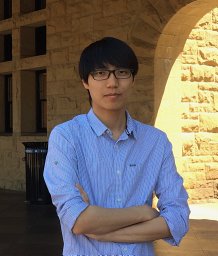
Yao Feng
Google Scholar ID: wNQQhSIAAAAJ
Stanford University
Citations & Impact
Citations
2,831
H-index
15
i10-index
17
Publications
20
Co-authors
23
list available
Publications
Resume (English only)
Academic Achievements
- ChatHuman: Chatting about 3D Humans with Tools (CVPR 2025)
- ChatGarment: Garment Estimation, Generation and Editing via Large Language Models (CVPR 2025)
- DiffLocks: Generating 3D Hair from a Single Image using Diffusion Models (CVPR 2025)
- ChatPose: Chatting about 3D Human Pose (CVPR 2024)
- TokenHMR: Advancing Human Mesh Recovery with a Tokenized Pose Representation (CVPR 2024)
- MonoHair: High-Fidelity Hair Modeling from a Monocular Video (CVPR 2024)
- Ghost on the Shell: An Expressive Representation of General 3D Shapes (ICLR 2024)
- BOFT: Parameter-Efficient Orthogonal Finetuning via Butterfly Factorization (ICLR 2024)
- TECA: Text-Guided Generation and Editing of Compositional 3D Avatars (3DV 2024)
- DELTA: Learning Disentangled Avatars with Hybrid 3D Representations (project page/arXiv)
- MeshDiffusion: Score-based Generative 3D Mesh Modeling (ICLR 2023)
- SCARF: Capturing and Animation of Body and Clothing from Monocular Video (Siggraph Asia Conference 2022)
- PIXIE: Collaborative Regression of Expressive Bodies using Moderation (3DV 2021)
- DECA: Learning an Animatable Detailed 3D Face Model from In-The-Wild Images (SIGGRAPH 2021)
- PRNet: Joint 3D Face Reconstruction and Dense Alignment with Position Map Regression Network (ECCV 2018)
Research Experience
- Postdoc at Stanford University, working with Karen Liu, Jennifer Hicks, and Scott L. Delp; Research scientist at Meshcapade for one year.
Education
- PhD: ETH Zürich and Max Planck Institute for Intelligent Systems; Supervisors: Michael J. Black and Marc Pollefeys
Background
- Research Interests: Capturing and understanding digital humans at scale, with applications across multiple disciplines, including computer vision, computer graphics, biomechanics, and robotics.