A Benchmark of Dexterity for Anthropomorphic Robotic Hands
career value
204K/year
🤖 AI Summary
This work addresses the lack of a unified, performance-based definition of dexterity in anthropomorphic robotic hands, which hinders cross-platform comparison. To bridge this gap, the paper introduces POMDAR—a novel benchmark that establishes the first open-source, standardized framework for evaluating dexterity grounded in human motor control taxonomy. Dexterity is formalized as performance across four structured manipulation and grasping task categories. The benchmark incorporates a throughput scoring mechanism that jointly considers task correctness and execution speed, complemented by mechanical constraint design and quantitative evaluation algorithms. Validated in both real-world and simulated environments, POMDAR enables objective, reproducible assessments. By providing a complete open-source toolchain, it facilitates consistent, interpretable comparisons of dexterity across diverse robotic hands, thereby advancing the systematic development of dexterous manipulation systems.
Application Category
📝 Abstract
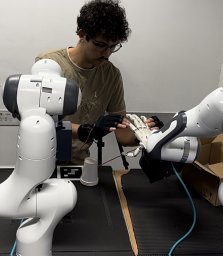
Dexterity is a central yet ambiguously defined concept in the design and evaluation of anthropomorphic robotic hands. In practice, the term is often used inconsistently, with different systems evaluated under disparate criteria, making meaningful comparisons across designs difficult. This highlights the need for a unified, performance-based definition of dexterity grounded in measurable outcomes rather than proxy metrics. In this work, we introduce POMDAR, a comprehensive dexterity benchmark that formalizes dexterity as task performance across a structured set of manipulation and grasping motions. The benchmark was systematically derived from established taxonomies in human motor control. It is implemented in both real-world and simulation and includes four manipulation configurations: vertical and horizontal configurations, continuous rotation, and pure grasping. The task designs contain mechanical scaffolding to constrain task motion, suppress compensatory strategies, and enable metrics to be measured unambiguously. We define a quantitative scoring metric combining task correctness and execution speed, effectively measuring dexterity as throughput. This enables objective, reproducible, and interpretable evaluation across different hand designs. POMDAR provides an open-source, standardized, and taxonomy-grounded benchmark for consistent comparison and evaluation of anthropomorphic robot hands to facilitate a systematic advancement of dexterous manipulation platforms. CAD, simulation files, and evaluation videos are publicly available at https://srl-ethz.github.io/POMDAR/.
Problem
Research questions and friction points this paper is trying to address.
dexterity
anthropomorphic robotic hands
benchmark
manipulation
grasping
Innovation
Methods, ideas, or system contributions that make the work stand out.
dexterity benchmark
anthropomorphic robotic hands
task-based evaluation
manipulation taxonomy
quantitative scoring
🔎 Similar Papers
No similar papers found.