Energy-based Regularization for Learning Residual Dynamics in Neural MPC for Omnidirectional Aerial Robots
career value
168K/year
🤖 AI Summary
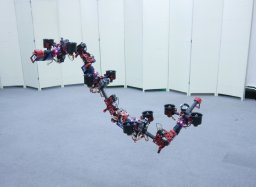
This work addresses the lack of physical consistency—such as inertia and energy conservation—in learned residual dynamics models commonly employed in neural model predictive control (MPC), which can compromise control stability. To mitigate this issue, the authors propose an energy-conserving regularization method that incorporates system-energy-based constraints during the training of deep neural networks, thereby enhancing the physical plausibility of the residual model. The regularized model is integrated into an MPC framework for trajectory tracking of an omnidirectional aerial robot. Experimental results demonstrate that the proposed approach reduces the mean absolute position error (MAE) by 23% on average across three real-world flight tasks compared to analytical MPC, and further decreases MAE by up to 15% relative to unregularized neural MPC, while significantly improving flight stability.
Application Category
📝 Abstract
Data-driven Model Predictive Control (MPC) has lately been the core research subject in the field of control theory. The combination of an optimal control framework with deep learning paradigms opens up the possibility to accurately track control tasks without the need for complex analytical models. However, the system dynamics are often nuanced and the neural model lacks the potential to understand physical properties such as inertia and conservation of energy. In this work, we propose a novel energy-based regularization loss function which is applied to the training of a neural model that learns the residual dynamics of an omnidirectional aerial robot. Our energy-based regularization encourages the neural network to cause control corrections that stabilize the energy of the system. The residual dynamics are integrated into the MPC framework and improve the positional mean absolute error (MAE) over three real-world experiments by 23% compared to an analytical MPC. We also compare our method to a standard neural MPC implementation without regularization and primarily achieve a significantly increased flight stability implicitly due to the energy regularization and up to 15% lower MAE. Our code is available under: https://github.com/johanneskbl/jsk_aerial_robot/tree/develop/neural_MPC.
Problem
Research questions and friction points this paper is trying to address.
Neural MPC
residual dynamics
energy conservation
omnidirectional aerial robots
flight stability
Innovation
Methods, ideas, or system contributions that make the work stand out.
energy-based regularization
neural MPC
residual dynamics
omnidirectional aerial robots
model predictive control
🔎 Similar Papers
No similar papers found.
💼 Related Jobs