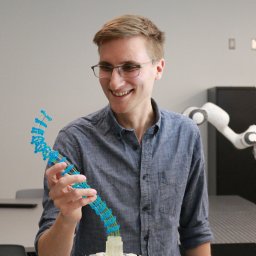
A Stochastic Framework for Continuous-Time State Estimation of Continuum Robots
career value
184K/year
🤖 AI Summary
Existing continuum robot state estimation methods suffer from sensitivity to unmodeled disturbances, reliance on complex dynamic models, or restrictive quasi-static assumptions. To address these limitations, this paper proposes a continuous-time stochastic estimation framework based on factor graph optimization. The approach formulates kinematic factors using a continuous-time kinematic model driven by Gaussian white noise, fusing high-frequency gyroscope measurements with sparse pose observations while incorporating continuous-time Gaussian process modeling to jointly estimate pose, velocity, and strain over space and time. By explicitly exploiting the sparsity structure of the factor graph, the algorithm achieves linear-time complexity and constant-time interpolation, significantly enhancing robustness against external disturbances and measurement dropouts. Experimental validation on a physical continuum robot demonstrates that the method maintains high accuracy while substantially reducing computational cost, enabling real-time performance and practical deployability.
Application Category
📝 Abstract
State estimation techniques for continuum robots (CRs) typically involve using computationally complex dynamic models, simplistic shape approximations, or are limited to quasi-static methods. These limitations can be sensitive to unmodelled disturbances acting on the robot. Inspired by a factor-graph optimization paradigm, this work introduces a continuous-time stochastic state estimation framework for continuum robots. We introduce factors based on continuous-time kinematics that are corrupted by a white noise Gaussian process (GP). By using a simple robot model paired with high-rate sensing, we show adaptability to unmodelled external forces and data dropout. The result contains an estimate of the mean and covariance for the robot's pose, velocity, and strain, each of which can be interpolated continuously in time or space. This same interpolation scheme can be used during estimation, allowing for inclusion of measurements on states that are not explicitly estimated. Our method's inherent sparsity leads to a linear solve complexity with respect to time and interpolation queries in constant time. We demonstrate our method on a CR with gyroscope and pose sensors, highlighting its versatility in real-world systems.
Problem
Research questions and friction points this paper is trying to address.
Develops continuous-time state estimation for continuum robots
Addresses sensitivity to unmodeled disturbances and data dropout
Estimates robot pose, velocity and strain with spatiotemporal interpolation
Innovation
Methods, ideas, or system contributions that make the work stand out.
Continuous-time stochastic framework for continuum robot state estimation
Factor-graph optimization with white noise Gaussian process kinematics
Sparse linear solve complexity with constant-time interpolation queries
🔎 Similar Papers
💼 Related Jobs