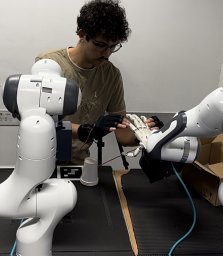
Beyond Anthropomorphism: Enhancing Grasping and Eliminating a Degree of Freedom by Fusing the Abduction of Digits Four and Five
career value
195K/year
🤖 AI Summary
To address the limited reachable workspace and the trade-off between actuator redundancy and dexterity in anthropomorphic robotic hands, this paper proposes a non-anthropomorphic SABD hand. Its core innovation lies in merging the abduction/adduction degrees of freedom of the fourth and fifth fingers into a single shared joint, thereby circumventing anatomical constraints inherent in the human hand. This design expands the operational workspace by 400%, significantly reduces the number of actuators, and simultaneously enhances grasp stability and manipulative pose diversity. Through integrated structural optimization and reinforcement learning–driven grasp planning, the hand achieves a maximum lateral grasp span of 200 mm in teleoperation experiments and attains an 86% success rate on the YCB Object Set. These results demonstrate its high robustness and broad applicability across diverse manipulation tasks.
Application Category
📝 Abstract
This paper presents the SABD hand, a 16-degree-of-freedom (DoF) robotic hand that departs from purely anthropomorphic designs to achieve an expanded grasp envelope, enable manipulation poses beyond human capability, and reduce the required number of actuators. This is achieved by combining the adduction/abduction (Add/Abd) joint of digits four and five into a single joint with a large range of motion. The combined joint increases the workspace of the digits by 400% and reduces the required DoFs while retaining dexterity. Experimental results demonstrate that the combined Add/Abd joint enables the hand to grasp objects with a side distance of up to 200 mm. Reinforcement learning-based investigations show that the design enables grasping policies that are effective not only for handling larger objects but also for achieving enhanced grasp stability. In teleoperated trials, the hand successfully performed 86% of attempted grasps on suitable YCB objects, including challenging non-anthropomorphic configurations. These findings validate the design's ability to enhance grasp stability, flexibility, and dexterous manipulation without added complexity, making it well-suited for a wide range of applications.
Problem
Research questions and friction points this paper is trying to address.
Reducing robotic hand actuators while maintaining dexterity
Expanding grasp envelope beyond human capability
Enhancing grasp stability through non-anthropomorphic digit fusion
Innovation
Methods, ideas, or system contributions that make the work stand out.
Fused abduction joints for digits four and five
Single joint with large motion range
Reduced actuators while retaining dexterity
🔎 Similar Papers
2024-09-23arXiv.orgCitations: 0