Learning Decentralized Multi-Biped Control for Payload Transport
career value
212K/year
🤖 AI Summary
This work addresses coordinated heavy-load transportation by legged robots on rough terrain. Method: We propose a decentralized, scale-invariant distributed control framework enabling plug-and-play integration of arbitrary numbers and configurations of rigidly coupled bipedal robots (e.g., Cassie) without retraining. Our approach employs reinforcement learning–based distributed policy training, local state-sharing observation design, high-fidelity simulation modeling, and domain-adaptive deployment techniques. Contribution/Results: To our knowledge, this is the first scalable multi-biped load-transportation system. The controller is fully decentralized, generalizes across robot counts and configurations, and enables seamless sim-to-real transfer. Extensive evaluations on diverse terrains in simulation demonstrate stability and robustness. We further validate the framework on physical hardware with two and three Cassie robots performing synchronized load transport—establishing the first scalable, real-world demonstrable paradigm for bipedal robot swarms.
Application Category
📝 Abstract
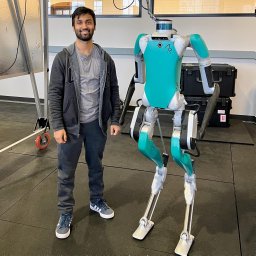
Payload transport over flat terrain via multi-wheel robot carriers is well-understood, highly effective, and configurable. In this paper, our goal is to provide similar effectiveness and configurability for transport over rough terrain that is more suitable for legs rather than wheels. For this purpose, we consider multi-biped robot carriers, where wheels are replaced by multiple bipedal robots attached to the carrier. Our main contribution is to design a decentralized controller for such systems that can be effectively applied to varying numbers and configurations of rigidly attached bipedal robots without retraining. We present a reinforcement learning approach for training the controller in simulation that supports transfer to the real world. Our experiments in simulation provide quantitative metrics showing the effectiveness of the approach over a wide variety of simulated transport scenarios. In addition, we demonstrate the controller in the real-world for systems composed of two and three Cassie robots. To our knowledge, this is the first example of a scalable multi-biped payload transport system.
Problem
Research questions and friction points this paper is trying to address.
Develop decentralized control for multi-biped payload transport
Enable adaptable control without retraining for varying configurations
Achieve effective rough terrain transport using bipedal robots
Innovation
Methods, ideas, or system contributions that make the work stand out.
Decentralized controller for multi-biped robots
Reinforcement learning for real-world transfer
Scalable without retraining for various configurations
🔎 Similar Papers
No similar papers found.