A Design Space for Visualization Transitions of 3D Spatial Data in Hybrid AR-Desktop Environments
career value
212K/year
🤖 AI Summary
High cognitive load arises when switching 3D spatial data between 2D and 3D representations in hybrid augmented reality (AR)–desktop environments.
Method: This paper introduces the first design space for 3D visualization transitions tailored to hybrid display environments. Its core innovation is the “spatial encoding pipeline” model, which unifies data-dimensional transformation and visual mapping, enabling smooth animated transitions via structured interpolation between pipelines. The method integrates animation interpolation techniques with AR–desktop co-rendering mechanisms to support dynamic, cross-modal, multi-dimensional data integration.
Contribution/Results: Evaluated across astronomy, radiology, and chemistry case studies, the approach demonstrates effectiveness in enhancing users’ comprehension of multidimensional data relationships and interactive experience. It yields reusable transition design patterns, significantly improving both analytical efficiency and usability in hybrid visualization contexts.
Application Category
📝 Abstract
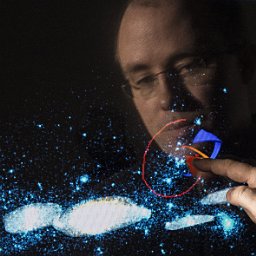
We present a design space for animated transitions of the appearance of 3D spatial datasets in a hybrid Augmented Reality (AR)-desktop context. Such hybrid interfaces combine both traditional and immersive displays to facilitate the exploration of 2D and 3D data representations in the environment in which they are best displayed. One key aspect is to introduce transitional animations that change between the different dimensionalities to illustrate the connection between the different representations and to reduce the potential cognitive load on the user. The specific transitions to be used depend on the type of data, the needs of the application domain, and other factors. We summarize these as a transition design space to simplify the decision-making process and provide inspiration for future designs. First, we discuss 3D visualizations from a spatial perspective: a spatial encoding pipeline, where 3D data sampled from the physical world goes through various transformations, being mapped to visual representations, and then being integrated into a hybrid AR-desktop environment. The transition design then focuses on interpolating between two spatial encoding pipelines to provide a smooth experience. To illustrate the use of our design space, we apply it to three case studies that focus on applications in astronomy, radiology, and chemistry; we then discuss lessons learned from these applications.
Problem
Research questions and friction points this paper is trying to address.
Designing animated transitions for 3D spatial data in hybrid AR-desktop environments
Reducing cognitive load by illustrating connections between 2D and 3D representations
Creating a transition design space for diverse data types and application domains
Innovation
Methods, ideas, or system contributions that make the work stand out.
Hybrid AR-desktop environment for 3D data
Transitional animations reduce cognitive load
Spatial encoding pipeline for smooth transitions
🔎 Similar Papers
No similar papers found.
💼 Related Jobs