ORCA: An Open-Source, Reliable, Cost-Effective, Anthropomorphic Robotic Hand for Uninterrupted Dexterous Task Learning
career value
188K/year
🤖 AI Summary
High-cost, bulky, and maintenance-intensive high-performance robotic hands hinder accessibility in dexterous manipulation research. To address this, we present ORCA—an open-source, anthropomorphic, tendon-driven robotic hand featuring 17 degrees of freedom, a cost under CHF 2,000, and assembly time under eight hours. ORCA integrates embedded tactile sensing and robust全天候 operation capability. Its design innovates with pop-up joints, self-calibration, and self-tensioning mechanisms—reducing hardware complexity while enhancing robustness, positional accuracy, and long-term reliability. We further develop an online calibration algorithm and a unified sim-to-real reinforcement learning and imitation learning framework, enabling teleoperation, zero-shot simulation-to-reality transfer, and sustained fault-free operation over 10,000 grasping cycles (~20 hours). All mechanical designs, firmware, software, and control stacks are fully open-sourced, establishing a cost-effective, reproducible, and standardized experimental platform for dexterous manipulation learning.
Application Category
📝 Abstract
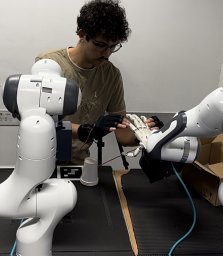
General-purpose robots should possess humanlike dexterity and agility to perform tasks with the same versatility as us. A human-like form factor further enables the use of vast datasets of human-hand interactions. However, the primary bottleneck in dexterous manipulation lies not only in software but arguably even more in hardware. Robotic hands that approach human capabilities are often prohibitively expensive, bulky, or require enterprise-level maintenance, limiting their accessibility for broader research and practical applications. What if the research community could get started with reliable dexterous hands within a day? We present the open-source ORCA hand, a reliable and anthropomorphic 17-DoF tendon-driven robotic hand with integrated tactile sensors, fully assembled in less than eight hours and built for a material cost below 2,000 CHF. We showcase ORCA's key design features such as popping joints, auto-calibration, and tensioning systems that significantly reduce complexity while increasing reliability, accuracy, and robustness. We benchmark the ORCA hand across a variety of tasks, ranging from teleoperation and imitation learning to zero-shot sim-to-real reinforcement learning. Furthermore, we demonstrate its durability, withstanding more than 10,000 continuous operation cycles - equivalent to approximately 20 hours - without hardware failure, the only constraint being the duration of the experiment itself. All design files, source code, and documentation will be available at https://www.orcahand.com/.
Problem
Research questions and friction points this paper is trying to address.
Develops affordable robotic hand for dexterous task learning
Addresses high cost and maintenance of current robotic hands
Enables rapid deployment with open-source design and sensors
Innovation
Methods, ideas, or system contributions that make the work stand out.
Open-source 17-DoF tendon-driven robotic hand
Integrated tactile sensors for dexterous tasks
Auto-calibration and tensioning systems enhance reliability
🔎 Similar Papers
No similar papers found.