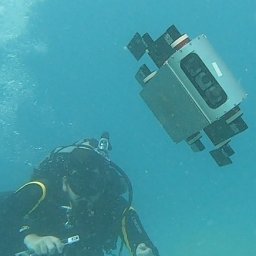
SHRUMS: Sensor Hallucination for Real-time Underwater Motion Planning with a Compact 3D Sonar
career value
229K/year
🤖 AI Summary
To address the challenge of 3D autonomous navigation in underwater low-visibility environments, this paper proposes a real-time motion planning system based on a compact 3D sonar. Methodologically, it introduces the first integration of 3D sonar into an underwater autonomous navigation framework and innovatively proposes a “sensor hallucination” mechanism—synthesizing virtual sonar measurements with arbitrary parameters to compensate for perceptual gaps in sparse or degraded real-world sensing. Coupled with online local mapping and locally optimal motion planning, the system achieves closed-loop perception–decision–control. Experiments demonstrate stable operation even in extremely turbid water, significantly enhancing navigation robustness and environmental adaptability. Key contributions are: (1) the first real-time 3D sonar integration scheme tailored for underwater navigation; and (2) a novel sensor hallucination paradigm that provides a generalizable enhancement strategy for autonomous decision-making under sparse or distorted perception.
Application Category
📝 Abstract
Autonomous navigation in 3D is a fundamental problem for autonomy. Despite major advancements in terrestrial and aerial settings due to improved range sensors including LiDAR, compact sensors with similar capabilities for underwater robots have only recently become available, in the form of 3D sonars. This paper introduces a novel underwater 3D navigation pipeline, called SHRUMS (Sensor Hallucination for Robust Underwater Motion planning with 3D Sonar). To the best of the authors' knowledge, SHRUMS is the first underwater autonomous navigation stack to integrate a 3D sonar. The proposed pipeline exhibits strong robustness while operating in complex 3D environments in spite of extremely poor visibility conditions. To accommodate the intricacies of the novel sensor data stream while achieving real-time locally optimal performance, SHRUMS introduces the concept of hallucinating sensor measurements from non-existent sensors with convenient arbitrary parameters, tailored to application specific requirements. The proposed concepts are validated with real 3D sonar sensor data, utilizing real inputs in challenging settings and local maps constructed in real-time. Field deployments validating the proposed approach in full are planned in the very near future.
Problem
Research questions and friction points this paper is trying to address.
Enables 3D autonomous navigation for underwater robots
Addresses poor visibility challenges in complex underwater environments
Integrates real-time 3D sonar data for motion planning
Innovation
Methods, ideas, or system contributions that make the work stand out.
Integrates 3D sonar for underwater navigation
Hallucinates sensor measurements for real-time optimization
Enables robust motion planning in poor visibility
🔎 Similar Papers
2024-03-15arXiv.orgCitations: 1
💼 Related Jobs