Scholar
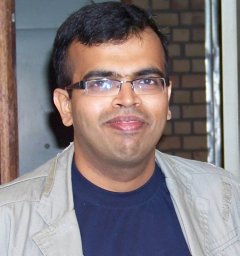
Anant Raj
Google Scholar ID: wpdabDgAAAAJ
Assistant Professor, Indian Institute of Science, Bengaluru
Citations & Impact
Citations
944
H-index
16
i10-index
23
Publications
20
Co-authors
15
list available
Publications
Resume (English only)
Academic Achievements
- August 2025: Received Pratiksha Trust Young Investigator Award; July 2025: Presented a paper on Mean-Field Optimisation at COLT 2025; March 2025: New preprint on Mean-Field Optimisation available; March 2025: Awarded Early Career Research Grant (PM-ECRG) by the Anusandhan National Research Foundation (ANRF); December 2024: Co-authored paper 'Variational Principles for Mirror Descent and Mirror Langevin Dynamics' with Belinda Tzen, Maxim Raginsky, and Francis Bach, honored with the 2024 IEEE CSS Roberto Tempo Best CDC Paper Award; November 2024: Awarded Google India Research Award, 2024; September 2024: Paper on policy gradient accepted to Neurips 2024; May 2024: Paper on practical policy gradient accepted at Reinforcement Learning Conference (RLC), 2024.
Research Experience
- Since October 2024, he has been an Assistant Professor in the Department of Computer Science and Automation (CSA) at the Indian Institute of Science (IISc), leading the Theoretical Foundations of ML and Optimization Lab (TFMLO Lab). Previously, he was a Marie-Curie Fellow, jointly hosted by Prof. Francis Bach at the SIERRA Project Team (Inria) and Prof. Maxim Raginsky at the Coordinated Science Laboratory (CSL), UIUC.
Education
- PhD: Max-Planck Institute for Intelligent Systems, Empirical Inference Department, supervised by Prof. Bernhard Schoelkopf; B.Tech-M.Tech dual degree: IIT Kanpur, Electrical Engineering, advised by Prof. Rajesh M Hegde, Prof. Vinay Namboodiri, Prof. Amitabha Mukerjee, and Prof. Tinne Tuytelaars (External Master's Thesis Advisor).
Background
- Research interests include optimization theory, kernel methods, and theoretical foundations of machine learning. He is also interested in resource-efficient learning such as active learning, coresets, and distributed inference. In terms of applications, he is interested in the use of machine learning methods in the healthcare domain.