Scholar
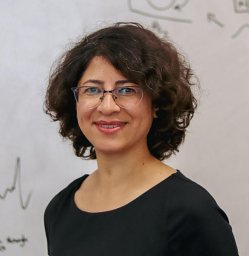
Fatemeh Hadaeghi
Google Scholar ID: tpHRyokAAAAJ
Universitätsklinikum Hamburg-Eppendorf (UKE)
Citations & Impact
Citations
246
H-index
9
i10-index
9
Publications
20
Co-authors
15
list available
Contact
Publications
Resume (English only)
Academic Achievements
- 1. Established a machine learning benchmark in online biosignal processing and optimized a reservoir computing-based neural learning algorithm, significantly surpassing the state-of-the-art on a chosen benchmark.
- 2. Designed a spiking reservoir computer simulated on BRIAN.
Research Experience
- 1. Exploring the design space of reservoir computing by introducing innovative classes of bio-inspired wiring diagrams.
- 2. Developing machine learning and AI methods to analyze wearable data in depression spectrum.
- 3. Employing sophisticated lesioning and multi-site perturbation methods to dissect the contributions of individual components of artificial neural networks in task performance.
- 4. Starting a Wellcome Trust Mental Health Award-funded project on validating a translatable chronobiological signature of early relapse in bipolar disorder (BD).
- 5. Conducted three years of postdoctoral research with Professor Herbert Jaeger at MINDS research group, working on spiking reservoir computing and its implementation on neuromorphic hardware as part of the EU NeuRAM3 project.
Education
- PhD in Biomedical Engineering from Amirkabir University of Technology (Tehran Polytechnic), Iran, focusing on modeling the dynamics of mood swings in bipolar disorders.
Background
- Research interests include NeuroAI and its applications in digital health. Specializes in the study of structures, dynamics, functions, and computation in biological and artificial recurrent (neural) networks, developing computational models for complex biological signals, systems, and phenomena. Particularly interested in the development of methods for wearable data processing.
Miscellany
- Strongly interested in biomedical signal and image processing algorithms, applications, and hardware implementation, particularly in recurrent neural networks for spatiotemporal modeling and analysis.