Scholar
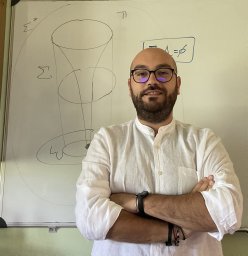
Martino Borello
Google Scholar ID: meWzEVAAAAAJ
Université Paris 8 - Laboratoire Analyse Géométrie et Algèbre
Citations & Impact
Citations
453
H-index
12
i10-index
15
Publications
20
Co-authors
12
list available
Contact
Publications
Cited
1
Resume (English only)
Academic Achievements
- Preprints:
- - Delsarte duality on subspaces and applications to rank-metric codes and q-matroids
- - Linear rank-metric intersecting codes
- - Evaluation of Forms for Distinguishing Rank-Metric Codes
- - Left ideal LRPC codes and a ROLLO-type cryptosystem based on group algebras
- Publications (in reverse chronological order):
- - A geometric invariant of linear rank-metric codes
- - Dihedral Quantum Codes
- - The geometry of covering codes in the sum-rank metric
- - The geometry of intersecting codes and applications to additive combinatorics and factorization theory
- - Outer strong blocking sets
- - Saturating linear sets of minimal rank
- - Geometric dual and sum-rank minimal codes
- - Twisted skew G-codes
- - Saturating systems and rank covering radius
- - Small strong blocking sets by concatenation
- - Linear cutting blocking sets and minimal codes in the rank metric
- - On ideals in group algebras: an uncertainty principle and the Schur product
- - On the algebraic structure of quasi group codes
- - Three combinatorial perspectives on minimal codes
- - The uncertainty principle over finite fields
- - A geometric characterization of minimal codes and their asymptotic performance
- - On checkable codes in group algebras
Research Experience
- Lecturer at Université Paris 8; Member of LAGA, AGC3; Member of the Department of Mathematics, UFR STN.
Education
- Information not provided
Background
- Research interests: algebraic coding theory, finite geometry, and combinatorics. Early research focused on self-dual codes and their automorphisms, particularly extremal codes. Current work mainly explores G-codes (quasi-cyclic codes with additional symmetries), minimal and intersecting codes, and rank-metric codes. These families exhibit intriguing connections with other areas of mathematics, such as representation theory, finite geometry, and combinatorics, as well as potential applications in cryptography. He is also interested in problems related to Euclidean lattices, the Möbius function of subgroups, and the arithmetic of finite fields.
Miscellany
- Email: surname @math.univ-paris13.fr (research), name.surname @univ-paris8.fr (teaching); Office: D316 (Paris 13), A141-MR111 (Paris 8)