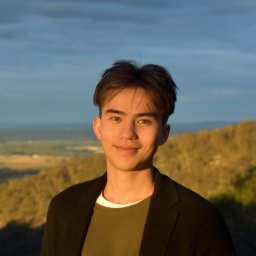
David Hyland
Scholar

David Hyland

Google Scholar ID: izVwRKkAAAAJ
University of Oxford
Bounded RationalityGame TheoryCollective IntelligenceAI Alignment
Citations & Impact
All-time
Citations
31
 
H-index
4
 
i10-index
0
 
Publications
14
 
Co-authors
0
 
Resume (English only)
Academic Achievements
  • 1. Has a Google Scholar profile.
  • 2. Involved in multiple research projects, including performance benchmarking for the DBFT consensus algorithm, 2D agent-based models of immune cell interactions, development of an automated hyperparameter optimisation method, and study and implementation of an entropy-regularised continuous time Reinforcement Learning algorithm.
Research Experience
  • 1. Worked with Gauthier Voron and Vincent Gramoli on performance benchmarking for the DBFT consensus algorithm on the Corda blockchain.
  • 2. Initiated a TSP project with Peter Kim, where he studied, implemented, and built animated visualisations of 2D agent-based models of immune cell interactions in C++.
  • 3. Did a research internship in bioinformatics at The Kinghorn Cancer Centre, where he devised and implemented an automated hyperparameter optimisation method based on binary search and wrote a parallelised implementation of a Nanopore DNA analysis algorithm using SIMD.
  • 4. Studied and implemented an entropy-regularised continuous time Reinforcement Learning algorithm under the supervision of Zhou Zhou.
Education
  • Currently a fourth-year DPhil student at the University of Oxford, supervised by Michael Wooldridge and Julian Gutierrez. Prior to Oxford, he studied at the University of Sydney and undertook several research projects as an undergraduate.
Background
  • Interests include incentives and collective agency as frameworks for understanding and shaping coordination in real-world multi-agent systems, involving both humans and AI systems. Work involves game theory, bounded rationality, collective intelligence, and models of human cognition.
Miscellany
  • Welcomes opportunities for collaboration and discussion in these research areas.
Co-authors
0 total
Co-authors: 0 (list not available)