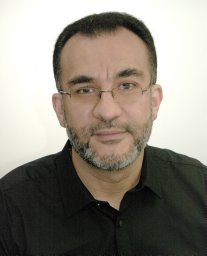
Scholar
Farid Boussaid
Google Scholar ID: SacY05oAAAAJ
The University of Western Australia
Citations & Impact
Citations
6,102
H-index
36
i10-index
65
Publications
20
Co-authors
0
Contact
No contact links provided.
Publications
Resume (English only)
Academic Achievements
- - Published well over 145 papers
- - Recipient of five international Best Paper Awards
- - Fellowships from the Australian Research Council (ARC), National Science Foundation (NSF, USA) and Tokyo University of Science
- - Recognized with a 2016 citation for outstanding contribution to Student Learning by the Australian Department of Education and Training
- - Appointed Head of the School of Electrical, Electronic, & Computer Engineering at UWA from 2014-2017
Research Experience
- - Joined Edith Cowan University as a Post-Doctoral Research Fellow and a member of the Visual Information Processing Research Group in March 2000.
- - Recipient of an Australian Research Council APD Fellowship in December 2001 to develop a new generation of smart vision sensors featuring on-chip and pixel-level implementation of human vision-based algorithms.
- - Joined The University of Western Australia (UWA) as a lecturer in 2005, currently a Professor in the School of Electrical, Electronic and Computer Engineering (ECEE).
Education
- - Degrees: M.S., Ph.D.
- - School: National Institute of Applied Science (INSA), Toulouse, France
- - Time: Received M.S. in 1996 and Ph.D. in 1999
Background
- - Research Interests: Microelectronics, Mixed-mode integrated circuit design, Machine learning / deep learning, Neuromorphic engineering, Gas sensors, Camera-on-a-chip, Smart sensors, Computer vision
- - Professional Field: Electrical, Electronic and Computer Engineering
- - Biography: Professor Farid Boussaid has pursued a broad and intrinsically interdisciplinary research agenda focused mainly on the design, implementation and fabrication of low cost highly integrated smart sensing systems. He also investigated a neuromorphic approach that seeks to emulate the key signal processing mechanisms occurring in the olfactory and visual pathways.
Co-authors