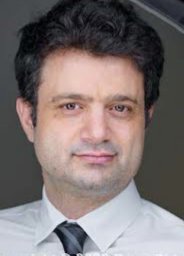
Scholar
Michael T. Schaub
Google Scholar ID: FCGOxvYAAAAJ
RWTH Aachen University
Networks
Applied Dynamical Systems
Neuroscience
Data Science
Graph Signal Processing
Follow
Homepage
↗
Google Scholar
↗
Citations & Impact
All-time
Citations
5,141
H-index
33
i10-index
54
Publications
20
Co-authors
85
list available
Contact
Email
michael.schaub@rwth-aachen.de
CV
Open ↗
GitHub
Open ↗
LinkedIn
Open ↗
Publications
17 items
Position: Message-passing and spectral GNNs are two sides of the same coin
2026
Cited
0
Higher order trade-offs in hypergraph community detection
2026
Cited
0
Grassmanian Interpolation of Low-Pass Graph Filters: Theory and Applications
2025
Cited
0
Faster Inference of Cell Complexes from Flows via Matrix Factorization
2025
Cited
0
Global Ground Metric Learning with Applications to scRNA data
2025
Cited
0
Don't be Afraid of Cell Complexes! An Introduction from an Applied Perspective
2025
Cited
0
HLSAD: Hodge Laplacian-based Simplicial Anomaly Detection
2025
Cited
0
Efficient Sparsification of Simplicial Complexes via Local Densities of States
2025
Cited
0
Load more
Resume (English only)
Academic Achievements
Preprint 'Don’t be afraid of cell complexes' released on arXiv in June 2025
Two 2025 preprints on arXiv: one on gradient descent training of GNNs, another on sparsification of simplicial complexes
Paper on learning dynamics on hypergraphs published in Science Advances (May 2024)
Paper accepted at ICLR 2024 and available on arXiv (April 2024)
Three papers accepted at ICASSP 2023 (December 2023)
Three papers accepted at Learning on Graph conference in 2023, one receiving Best Paper Award
Paper accepted at Asilomar 2023 (December 2023)
Multiple arXiv preprints on graph learning, optimal transport, microaggregation, spectral properties of Hodge-Laplacian, etc.
Background
Tenure track assistant professor at RWTH Aachen University, Germany
Research focuses on the analysis of complex systems abstracted as networks or graphs
Central interest: studying and integrating multiple levels of organization in complex systems
Combines bottom-up dynamical models with top-down data-driven approaches
Uses tools from control theory, dynamical systems, stochastic processes, machine learning, and statistics

Co-authors
85 total
Mauricio Barahona
Imperial College London, Applied Mathematics, Chair in Biomathematics
Jean-Charles Delvenne
Professor of Applied Mathematics, Université catholique de Louvain
Renaud Lambiotte
Professor of Networks and Nonlinear Systems, University of Oxford
Santiago Segarra
Associate Professor, Electrical and Computer Engineering, Rice University
Ali Jadbabaie
JR East Professor of Engineering, MIT
Co-author 6
Co-author 7
Mustafa Hajij
Assistant Professor of Machine Learning, University of San Francisco
×
Welcome back
Sign in to Agora
Welcome back! Please sign in to continue.
Email address
Password
Forgot password?
Continue
Do not have an account?
Sign up