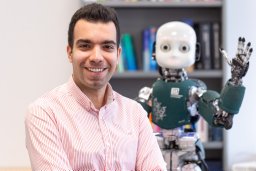
Surena-V: A Humanoid Robot for Human-Robot Collaboration with Optimization-based Control Architecture
career value
268K/year
🤖 AI Summary
Humanoid robots face significant challenges in achieving both dynamic stability and dexterous manipulation during real-time human–robot collaboration in unstructured, interactive environments.
Method: Surena-V introduces a local balance response mechanism based on contact-point force sensing, overcoming the limitations of conventional whole-body ZMP (Zero-Moment Point) control. It integrates upper-body motion modulation of ZMP with adaptive gait optimization, establishing an optimized control architecture featuring tactile closed-loop feedback, spatial decomposition of external forces, and real-time gait planning. Its hands incorporate pneumatic tactile sensors enabling soft-tissue-level puncture precision.
Results: Experimental validation demonstrates sub-millimeter accuracy in medical needle manipulation and successful human–robot collaborative bar-lifting tasks. The system achieves enhanced adaptability to dynamic environmental changes and significantly improved real-time cooperative performance.
Application Category
📝 Abstract
This paper presents Surena-V, a humanoid robot designed to enhance human-robot collaboration capabilities. The robot features a range of sensors, including barometric tactile sensors in its hands, to facilitate precise environmental interaction. This is demonstrated through an experiment showcasing the robot’s ability to control a medical needle’s movement through soft material. Surena-V’s operational framework emphasizes stability and collaboration, employing various optimization-based control strategies such as Zero Moment Point (ZMP) modification through upper body movement and stepping. Notably, the robot’s interaction with the environment is improved by detecting and interpreting external forces at their point of effect, allowing for more agile responses compared to methods that control overall balance based on external forces. The efficacy of this architecture is substantiated through an experiment illustrating the robot’s collaboration with a human in moving a bar. This work contributes to the field of humanoid robotics by presenting a comprehensive system design and control architecture focused on human-robot collaboration and environmental adaptability.
Problem
Research questions and friction points this paper is trying to address.
Human-robot collaboration
Balance control
Precision manipulation
Innovation
Methods, ideas, or system contributions that make the work stand out.
Haptic Sensors
Adaptive Control
Human-Robot Collaboration
🔎 Similar Papers
2024-09-19Citations: 0
💼 Related Jobs