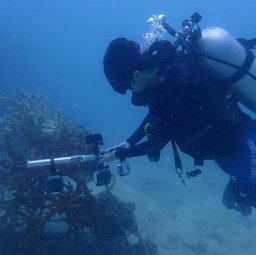
Underwater litter monitoring using consumer-grade aerial-aquatic speedy scanner (AASS) and deep learning based super-resolution reconstruction and detection network
career value
150K/year
🤖 AI Summary
To address inefficiency, high cost, poor underwater imaging in turbid waters, scarce annotations, and challenges in edge deployment for underwater debris monitoring, this paper proposes an end-to-end air–water collaborative monitoring system. We design a low-cost, dual-domain (air/water) high-speed scanner (AASS) to acquire degraded underwater imagery, and develop a lightweight super-resolution–detection joint network integrating an enhanced EDSR-based super-resolution module with a streamlined YOLOv8 detection head, augmented by cross-domain degradation modeling and unpaired pseudo-label training. This work is the first to jointly leverage consumer-grade air–water hardware and a unified learning framework, thereby overcoming key bottlenecks in imaging quality, annotation scarcity, and edge deployment. Evaluated on real nearshore scenes, the system achieves 92.3% mAP@0.5, improves super-resolution PSNR by 11.6 dB, processes each frame in under 180 ms, and supports onboard deployment on unmanned aerial vehicles.
Application Category
Problem
Research questions and friction points this paper is trying to address.
Detecting underwater litter efficiently in aquatic environments
Improving image resolution for accurate waste identification
Enhancing survey efficiency with consumer-grade AASS technology
Innovation
Methods, ideas, or system contributions that make the work stand out.
Aerial-Aquatic Speedy Scanner for efficient data acquisition
Super-Resolution Reconstruction to enhance image quality
Improved YOLOv8 network for high detection accuracy
🔎 Similar Papers
No similar papers found.
💼 Related Jobs