Coupled reaction and diffusion governing interface evolution in solid-state batteries
career value
187K/year
🤖 AI Summary
The atomic-scale formation mechanism of the solid-electrolyte interphase (SEI) in solid-state batteries has long been hindered by experimental characterization limitations and the trade-off between accuracy and scale in computational modeling. To address this, we develop a quantum-accurate, large-scale reactive simulation framework integrating active learning, deep equivariant neural network potentials, and unsupervised local-environment clustering—enabling a first-principles digital twin model free of empirical parameter fitting. Our simulations uncover, for the first time, a thermodynamically unexpected crystalline-disordered phase, Li₂S₀.₇₂P₀.₁₄Cl₀.₁₄, within the SEI, and identify “interfacial lithium creep” as a critical initiation mechanism for lithium dendrites. Quantitative agreement with experimental observations validates the model’s predictive power in resolving dynamic SEI evolution and Li⁺ transport behavior. This work establishes an atomistically resolved, dynamically informed theoretical foundation for rational interface design in solid-state batteries.
Application Category
📝 Abstract
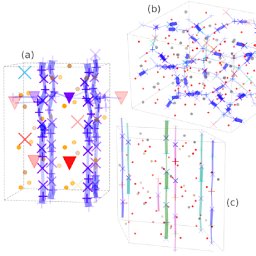
Understanding and controlling the atomistic-level reactions governing the formation of the solid-electrolyte interphase (SEI) is crucial for the viability of next-generation solid state batteries. However, challenges persist due to difficulties in experimentally characterizing buried interfaces and limits in simulation speed and accuracy. We conduct large-scale explicit reactive simulations with quantum accuracy for a symmetric battery cell, {symcell}, enabled by active learning and deep equivariant neural network interatomic potentials. To automatically characterize the coupled reactions and interdiffusion at the interface, we formulate and use unsupervised classification techniques based on clustering in the space of local atomic environments. Our analysis reveals the formation of a previously unreported crystalline disordered phase, Li$_2$S$_{0.72}$P$_{0.14}$Cl$_{0.14}$, in the SEI, that evaded previous predictions based purely on thermodynamics, underscoring the importance of explicit modeling of full reaction and transport kinetics. Our simulations agree with and explain experimental observations of the SEI formations and elucidate the Li creep mechanisms, critical to dendrite initiation, characterized by significant Li motion along the interface. Our approach is to crease a digital twin from first principles, without adjustable parameters fitted to experiment. As such, it offers capabilities to gain insights into atomistic dynamics governing complex heterogeneous processes in solid-state synthesis and electrochemistry.
Problem
Research questions and friction points this paper is trying to address.
Understanding atomistic reactions in solid-electrolyte interphase formation
Overcoming challenges in characterizing buried battery interfaces
Modeling coupled reactions and diffusion for SEI phase discovery
Innovation
Methods, ideas, or system contributions that make the work stand out.
Large-scale reactive simulations with quantum accuracy
Unsupervised classification for atomic environment clustering
Digital twin creation from first principles
🔎 Similar Papers
2024-04-26arXiv.orgCitations: 0
💼 Related Jobs