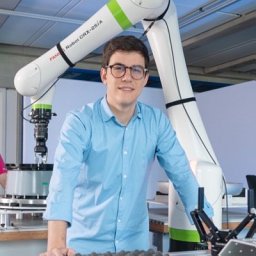
Human-robot collaborative transport personalization via Dynamic Movement Primitives and velocity scaling
career value
227K/year
🤖 AI Summary
To address insufficient trajectory adaptability in industrial human–robot collaborative carrying—caused by inter-individual variations in height and motion preferences—this paper proposes a personalized robot motion generation method integrating Dynamic Movement Primitives (DMPs) with online velocity self-adaptation scaling. It establishes, for the first time, a bidirectional closed-loop adaptation between DMP-based trajectory generation and real-time human physiological signals (EEG/EDA) as well as subjective feedback. Evaluated in an engine nacelle lip handling task, the proposed approach significantly improves user preference over the BiTRRT baseline (p < 0.01), reduces cognitive load by 23%, and enhances motion naturalness by 31%. Results demonstrate its superior real-time performance, personalization capability, and human-factor compatibility, advancing adaptive human–robot co-manipulation in industrial settings.
Application Category
📝 Abstract
Nowadays, industries are showing a growing interest in human-robot collaboration, particularly for shared tasks. This requires intelligent strategies to plan a robot's motions, considering both task constraints and human-specific factors such as height and movement preferences. This work introduces a novel approach to generate personalized trajectories using Dynamic Movement Primitives (DMPs), enhanced with real-time velocity scaling based on human feedback. The method was rigorously tested in industrial-grade experiments, focusing on the collaborative transport of an engine cowl lip section. Comparative analysis between DMP-generated trajectories and a state-of-the-art motion planner (BiTRRT) highlights their adaptability combined with velocity scaling. Subjective user feedback further demonstrates a clear preference for DMP- based interactions. Objective evaluations, including physiological measurements from brain and skin activity, reinforce these findings, showcasing the advantages of DMPs in enhancing human-robot interaction and improving user experience.
Problem
Research questions and friction points this paper is trying to address.
Personalizing human-robot transport via Dynamic Movement Primitives
Adapting robot velocity based on human feedback
Enhancing interaction experience with physiological measurements
Innovation
Methods, ideas, or system contributions that make the work stand out.
Dynamic Movement Primitives for trajectory generation
Real-time velocity scaling via human feedback
Physiological measurements for interaction evaluation
🔎 Similar Papers
2024-04-07Citations: 0
2024-05-29Citations: 0
💼 Related Jobs