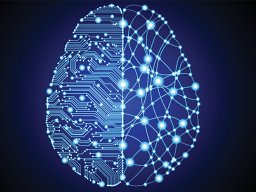
BrainFuse: a unified infrastructure integrating realistic biological modeling and core AI methodology
career value
235K/year
🤖 AI Summary
This work addresses the gap between biophysically realistic neural modeling and efficient, differentiable learning in artificial intelligence by introducing BrainFuse—the first unified infrastructure that fully integrates biophysical neuron models with end-to-end differentiable learning. Its core innovations include a differentiable Hodgkin-Huxley formulation, GPU-accelerated ion channel simulation achieving a 3,000× speedup, a neuromorphic-compatible pipeline, and a multi-scale simulation architecture. The system enables deployment of approximately 38,000 neurons and 100 million synapses on a single neuromorphic chip with a power consumption of only 1.98 W. Experimental results demonstrate substantial improvements in noise robustness and temporal processing capabilities for AI systems, bridging the divide between computational neuroscience and scalable, energy-efficient neuromorphic computing.
Application Category
📝 Abstract
Neuroscience and artificial intelligence represent distinct yet complementary pathways to general intelligence. However, amid the ongoing boom in AI research and applications, the translational synergy between these two fields has grown increasingly elusive-hampered by a widening infrastructural incompatibility: modern AI frameworks lack native support for biophysical realism, while neural simulation tools are poorly suited for gradient-based optimization and neuromorphic hardware deployment. To bridge this gap, we introduce BrainFuse, a unified infrastructure that provides comprehensive support for biophysical neural simulation and gradient-based learning. By addressing algorithmic, computational, and deployment challenges, BrainFuse exhibits three core capabilities: (1) algorithmic integration of detailed neuronal dynamics into a differentiable learning framework; (2) system-level optimization that accelerates customizable ion-channel dynamics by up to 3,000x on GPUs; and (3) scalable computation with highly compatible pipelines for neuromorphic hardware deployment. We demonstrate this full-stack design through both AI and neuroscience tasks, from foundational neuron simulation and functional cylinder modeling to real-world deployment and application scenarios. For neuroscience, BrainFuse supports multiscale biological modeling, enabling the deployment of approximately 38,000 Hodgkin-Huxley neurons with 100 million synapses on a single neuromorphic chip while consuming as low as 1.98 W. For AI, BrainFuse facilitates the synergistic application of realistic biological neuron models, demonstrating enhanced robustness to input noise and improved temporal processing endowed by complex HH dynamics. BrainFuse therefore serves as a foundational engine to facilitate cross-disciplinary research and accelerate the development of next-generation bio-inspired intelligent systems.
Problem
Research questions and friction points this paper is trying to address.
biophysical realism
gradient-based optimization
neuromorphic hardware
AI-neuroscience integration
neural simulation
Innovation
Methods, ideas, or system contributions that make the work stand out.
differentiable neuroscience
biophysical neural modeling
neuromorphic deployment
gradient-based learning
Hodgkin-Huxley dynamics
🔎 Similar Papers
2024-02-15Citations: 14
2024-01-30arXiv.orgCitations: 4
💼 Related Jobs