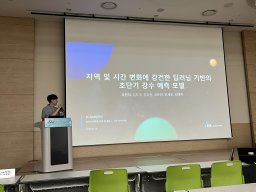
Station2Radar: query conditioned gaussian splatting for precipitation field
career value
187K/year
🤖 AI Summary
This study addresses key challenges in precipitation estimation—limited radar coverage, sparse ground stations, and the difficulty of directly retrieving rainfall from satellites—by proposing a Query-Conditioned Gaussian Splatting (QCGS) framework, which introduces Gaussian splatting to precipitation field modeling for the first time. Integrating a radar point proposal network with implicit neural representations, QCGS employs a query-driven mechanism to render only precipitating regions, achieving high computational efficiency without compromising structural fidelity. The framework supports flexible spatial resolution, real-time generation, and seamless fusion of multi-source meteorological observations. Experimental results demonstrate that QCGS reduces RMSE by over 50% compared to conventional gridded precipitation products across multiple spatiotemporal scales, substantially enhancing both reconstruction accuracy and generalization capability.
Application Category
📝 Abstract
Precipitation forecasting relies on heterogeneous data. Weather radar is accurate, but coverage is geographically limited and costly to maintain. Weather stations provide accurate but sparse point measurements, while satellites offer dense, high-resolution coverage without direct rainfall retrieval. To overcome these limitations, we propose Query-Conditioned Gaussian Splatting (QCGS), the first framework to fuse automatic weather station (AWS) observations with satellite imagery for generating precipitation fields. Unlike conventional 2D Gaussian splatting, which renders the entire image plane, QCGS selectively renders only queried precipitation regions, avoiding unnecessary computation in non-precipitating areas while preserving sharp precipitation structures. The framework combines a radar point proposal network that identifies rainfall-support locations with an implicit neural representation (INR) network that predicts Gaussian parameters for each point. QCGS enables efficient, resolution-flexible precipitation field generation in real time. Through extensive evaluation with benchmark precipitation products, QCGS demonstrates over 50\% improvement in RMSE compared to conventional gridded precipitation products, and consistently maintains high performance across multiple spatiotemporal scales.
Problem
Research questions and friction points this paper is trying to address.
precipitation forecasting
data fusion
weather stations
satellite imagery
precipitation field
Innovation
Methods, ideas, or system contributions that make the work stand out.
Query-Conditioned Gaussian Splatting
precipitation field generation
implicit neural representation
weather station-satellite fusion
selective rendering
🔎 Similar Papers
No similar papers found.
💼 Related Jobs